
What is AF?

What is AF?

AF is the most common sustained arrhythmia. It is most frequent in senior individuals. The prevalence of AF rises with age, affecting about 10 % of people aged 70 and over. It may carry an increased risk for stroke. The two small chambers of the heart no longer contract in a coordinated fashion. Thus, blood clots can form. These can be carried with the bloodstream into the brain, leading to stroke or obstructing other arteries. In addition, AF can lead to impaired heart function and even death. AF is diagnosed on the electrocardiogram (ECG). During its first stage, AF is usually an intermittent disease and may not be detected with a single-time point check.

Why is AF Screening offered?

Atrial fibrillation (AF) is often asymptomatic and estimates suggest that over a third of cases remain therefore undiagnosed.

Atrial fibrillation (AF) is often asymptomatic and estimates suggest that over a third of cases remain therefore undiagnosed. Many patients with AF are unaware of their disease, untreated, and at unnecessarily elevated risk of complications. A stroke is often the first manifestation leading to diagnosis of AF. At least one quarter of strokes in this population could have been prevented by earlier diagnosis of AF.
Do I belong to the individuals at risk of stroke?

The development of AF increases with age, from less than 0.2% in adults younger than 55 years to about 10% in those 85 years or older, with a higher prevalence in men than in women.

The development of AF increases with age, from less than 0.2% in adults younger than 55 years to about 10% in those 85 years or older, with a higher prevalence in men than in women. High blood pressure is present in almost 80% of all patients with AF. Other heart diseases, such as heart failure, valve defects, and coronary heart disease, as well as chronic kidney dysfunction, are also commonly associated with AF. Additional risk factors are thyroid dysfunction, obesity, diabetes mellitus, chronic lung diseases, sleep disordered breathing.

The risk of stroke due to AF also varies greatly. Young, heart-healthy people with AF are less at risk, whereas senior patients (65+) and patients with heart diseases are at high risk. An unhealthy lifestyle with excessive alcohol consumption, smoking and lack of exercise may contribute to the risk of stroke.

What kind of screening strategies are available?

Everyone can take their own pulse once in a while. Individuals over 65 and people with heart disease in particular could have their heart rate checked by their physicians during routine check-ups or other healthcare encounters. Wearable devices (smartwatches, smartphones and other devices) with a pulse measurement and/or ECG function can also be helpful. Devices with an ECG function can document AF directly. The ECG documentation from such wearables should be assessed by a physician in order to make the correct diagnosis.

Some of the devices that can be used for AF screening are shown below. Consumer-facing wearable devices can detect unknown AF at scale.

Patient initiated (or medical professional) oscillometric blood pressure cuff
Pulse palpation
Auscultation
Patient initiated (or medical professional) intermittent ECG rhythm strip using smartphone or dedicated connectable device
Patient initiated photoplethysmogram on smartphone
Semi-continuous photoplethysmogram on a smartwatch or wearable
Intermittent smartwatch ECG initiated by semi-continuous photoplethysmogram with prompt or symptoms
Wearable belts for continuous recordings
Stroke unit/in-hospital telemetry monitoring
Long-term Holter
1-2 week continuous ECG patches
Implantable cardiac monitors

What are the consequences of an AF Screening?

The ECG records the electrical activity of the heart muscle.

The ECG records the electrical activity of the heart muscle. The normal heartbeat shows a discrete impulse wave, the "P-wave" (atrial excitation). During AF this is replaced by small, disordered electrical signals (fibrillation waves).

Results of clinical studies have shown that the detection of AF is 3-fold to 10-fold higher in screened individuals compared to those who received the usual clinical practice procedures e.g. if a patient have noticeable symptoms such as rapid, irregular heartbeat an visit the general practitioner for a symptom driven check-up. Clinical studies of AF screening have shown a potential to reduce stroke risk when (asymptomatic) silent AF is detected by ECG, although the benefit was modest. It is postulated that more refined screening strategies can increase this benefit. E.g., intensive monitoring for AF can detect more cases than single time-point assessment. If AF only occurs from time to time, which is the case in many individuals, it can be detected by long-term monitoring which records the heart rhythm over 24 or 48 hours or even weeks. If there are more than a few days between AF events, "event recorders" implanted under the skin can be of further help.

What are the potential advantages of AF Screening?

The rationale for AF Screening approaches has been to prevent stroke, given that a patient with AF has a 5-fold increase in the risk of stroke compared to patients without AF.

The rationale for AF Screening approaches has been to prevent stroke, given that a patient with AF has a 5-fold increase in the risk of stroke compared to patients without AF. 20–30% of all stroke patients have are related to silent AF. Medication with anticoagulants (blood thinners) can reduce the risk of stroke by ≥64% and death by 26% in patients with AF. Earlier detection and anticoagulants intake for AF might reduce other complications. These include reduced pump function of the heart (the primary cause of death and the period of stay in a hospital in patients with AF) and possibly dementia.

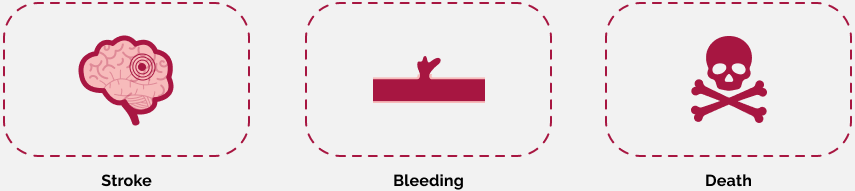
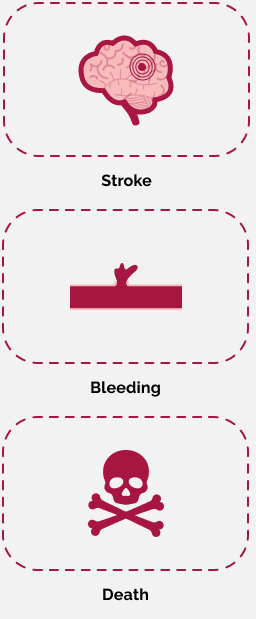
The risk of the events listed below is low in the screened population:

low-risk
low-risk-mob
Are there disadvantages to participating in AF Screening?

Are there disadvantages to participating in AF Screening?

If the screening results are not clear, additional work-up may be necessary and anxiety can occur. Additionally, while lifelong use of oral anticoagulants reduces the risk of strokes it can increase the risk of bleeding. However, clinical risk scores to stratify a patients risk according to their stroke or bleeding risk can help with the initial decision on whether to prescribe an anticoagulant for a patient or not, and help identify modifiable risk factors for bleeding.

What kind of preventive options do I have after the diagnosis of AF?

In general, treatment options for diagnosed AF consist of:

In general, treatment options for diagnosed AF consist of:

  • Stroke prevention through anticoagulants
    • In order to protect AF patients from stroke, they often have to be given lifelong medication to prevent blood clotting ("blood thinners").
  • Treatment to reduce symptoms.
    • The need for methods to restore the normal heart rhythm will be discussed.
    • This can be in the form of rhythm-control treatment to restore the heart’s natural rhythm (sinus rhythm) and/or rate-control treatment to restore a heart that is too fast or too slow to a normal heart rate is (60 to 80 beats per minute).
    • AF may also be stopped by electrical or pharmacologic cardioversion, or surgical or catheter ablation.
  • The treatment of concomitant diseases (co-morbidities) and risk factors that cause or promote AF burden and other complications such as impaired heart pump function, high blood pressure, and diabetes will be treated according to standards.

Take home messages regarding AF Screening

  • The risk of AF increases with age and comorbidities.
  • One third of AF is silent (asymptomatic).
  • Final evidence on the cost-benefit ratio of AF Screening is not yet available. Well-performed studies indicate a potential benefit. Information should emerge about which approach is most beneficial for specific patient groups.
  • If AF remains undetected, there is a risk for stroke and heart complications.
  • Oral anticoagulants and disease management involving the patient social environment may reduce the risk of adverse outcomes for patients with AF.